Showing posts with label AV. Show all posts

Saturday, June 30, 2012

[SR] Forces of Flight


There are four forces of flight -drag, thrust, weight and lift. All four play an important role in how planes fly.
 Drag
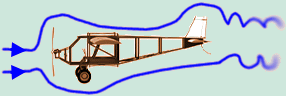
As the airplane moves through the air, there is an aerodynamic force present. The air resists the motion of the aircraft and the resistance force is called drag. Drag is directed along and opposed to the flight direction. There are many factors that affect the magnitude of the drag force including the shape of the aircraft, the "stickiness" of the air, and the velocity of the aircraft. We collect all of the individual components' drags and combine them into a single aircraft drag magnitude. Drag acts through the aircraft center of pressure. The drag of the air makes it hard for the plane to move quickly. Another name for drag is air resistance. A streamlined shape slips smoothly through the air. 


Thrust
To overcome drag, airplanes use a propulsion system to generate a force called thrust. The direction of the thrust force depends on how the engines are attached to the aircraft.
On some aircraft, such as the Harrier, the thrust direction can be varied to help the airplane take off in a very short distance. The magnitude of the thrust depends on many factors associated with the propulsion system including the type of engine, the number of engines, and the throttle setting.
For jet engines, it is often confusing to remember that aircraft thrust is a reaction to the hot gas rushing out of the nozzle. The hot gas goes out the back, but the thrust pushes towards the front. Action <--> reaction is explained by Newton's Third Law of Motion.


Lift

As the aircraft moves forward into a stream of air, the wing deflects the air. Some of the air moves to flow above the wing while some of the air moves to flow below the wing.
The wing is curved to help the air that flows above the wing move more quickly than the air that was able to flow below the non-curved bottom of the wing. This curve is called an aero-foil wing.


The air that is moving more quickly above the curved wing starts to put less pressure on the wing while it adjusts to its new stream. Meanwhile, the air that is moving at a consistent speed below the wing maintains its rate of pressure. This quick differential produces lift. The higher air pressure pushes the wing upward into the space where the air pressure is lower.The distribution of lift around the aircraft is important for solving the control problem. Aerodynamic surfaces are used to control the aircraft in roll, pitch, and yaw.

Weight


Weight is a force that is always directed toward the center of the earth. The magnitude of the weight depends on the mass of all the airplane parts, plus the amount of fuel, plus any payload on board (people, baggage, freight, etc.). The weight is distributed throughout the airplane. But we can often think of it as collected and acting through a single point called the center of gravity. In flight, the airplane rotates about the center of gravity.


The motion of the airplane through the air depends on the relative strength and direction of the forces shown above. If the forces are balanced, the aircraft cruises at constant velocity. If the forces are unbalanced, the aircraft accelerates in the direction of the largest force.

Saturday, June 16, 2012

[SR] Marvels of Aviation B787


Firstly, welcome to the 3-part mini series Marvels of Aviation, to see the other articles in this series, click the links above.

Aviation. The youngest mode of transportation at just over a 100 years old, but it has since become the premier way to travel long distances. 3 aircraft have changed commercial aviation and have contributed greatly to the advancement of technology for aircraft in the future. This is Marvels of Aviation.

Well, let's get started with a disclaimer. The 3 aircraft that I have chosen are for commercial aviation only, simply because I prefer the look of commercial aircraft to military aircraft.

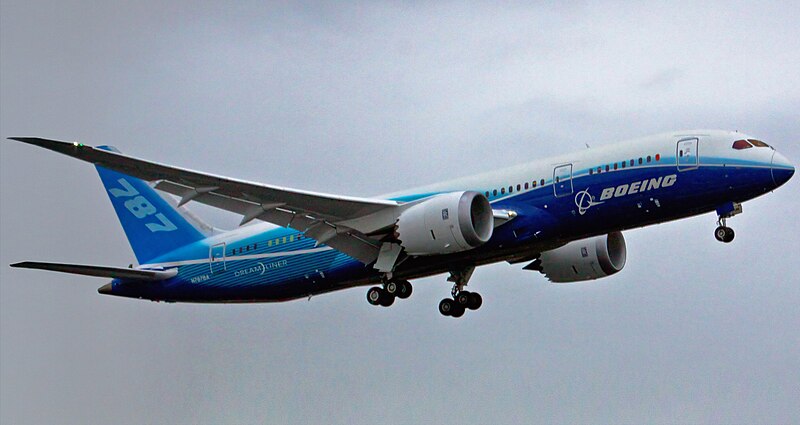
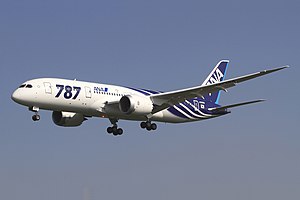
So, today, let's discuss the Boeing 787. Or what Boeing dubs, the Dreamliner.


It all began in 2001...

The global airline market was upended by the September 11, 2001 attacks and increased petroleum prices, making airlines more interested in efficiency than speed. The airlines in the United States, potential customers of a Sonic Cruiser Boeing was developing, were the worst hit. This caused Boeing to scrap the Sonic Cruiser plan and begin what was known as the 7E7. Boeing wanted to replace its entire airliner product line, in an endeavour known as the Yellowstone Project. The 7E7 was the first stage of that project. It was to replace its existing 767 and 777 product lines. The 7E7 is said to be the most efficient aircraft Boeing has ever created. The "E" was said to stand for various things, such as "efficiency" or "environmentally friendly"; however, in the end, Boeing claimed that it stood merely for "Eight". Boeing later changed its name to 787 in 2005, and it was finally rolled out in 2007, by which time it had reached 677 orders; this is more orders from launch to roll-out than any previous wide-body airliner. On October 26, 2011, the 787 flew its first commercial flight from Tokyo Narita Airport to Hong Kong International Airport on All Nippon Airways. But what made it such a marvel?


Its design. The 787 is primarily made out of composite materials.  Its materials, listed by weight, are 50% composite, 20% aluminium, 15% titanium, 10% steel, and 5% other. So what exactly are these composite materials?

Each 787 contains approximately 32,000 kg of carbon fibre reinforced plastic (CFRP), made with 23 tons of carbon fibre. Carbon fiber composites have a higher strength-to-weight ratio than traditional aircraft materials, and help make the 787 a lighter aircraft. Composites are used on fuselage, wings, tail, doors, and interior. This allows it to become Boeing's most efficient aircraft to date.


Boeing also designed its engines to reduce noise.The engines have have a toothed edge and Boeing calls them chevrons. It allows for a quieter mixing of exhaust and outside air.

Boeing also designed the interior to look and feel better for passengers. They designed the entrance to feel a lot more open so passengers won't feel as cramped. They have also widened the aircraft at eye level so it feels more roomy and spacious for passengers 


They also have cool windows that can tint with a press of a button. Replacing window shades, these cool windows have 5 different shade settings for passengers to personally adjust.


I'm sure that you'll agree with me after reading all these innovations the 787 has pioneered. And it truly is a marvel of aviation.

Saturday, June 2, 2012

[SR] Jet Engines


        When humans first observed how birds fly in the sky, they realized that it not only took the birds their light weight, and wings to get them flying, they needed speed. And since the day the Wright brothers built the Wright Plane, the propulsion of aircraft has also evolved, and today, the propeller that had propelled once propelled aircraft into the sky, has been replaced by a bigger, more efficient and faster alternative, the jet engine.
        Aviation is the youngest of all commercial transport and has the fastest growth as well. Many of us has flown on an aircraft before, yet many of us do not understand how the jet engine works. It is a fairly simple concept really, the idea is to suck air in and blast it out at higher speeds, but the technology involved with it is far more complicated.
        To start with, there are 4 types of engines, turbojet, turbofan, propfan, and turboprop.


Propfan
Turbofan


Turbojet
Turboprop


       A jet engine works by first sucking in and compressing the surrounding air through the axial compressor. The axial compressor comprises of both moving and stationary blades. The moving blades suck in the air while the stationary ones guide the air and ensures the air enters at the right angle. Then the air flows into the compressor which rotates at very high speed adding energy to the airflow and at the same time squeezing  it into a smaller space. They can compress the air in a 44:1 ratio. The air then moves into a combustion chamber where fuel is mixed in with the air and is ignited and the air would flow at a much faster speed. The temperature of this air would melt the turbine so the compressor directs some air into through a separate channel and this cooler air acts as a coolant for the jet engine. The turbine is another series of blades and it would make the air flow faster. The gas then exits through the nozzle and blasts the aircraft forward.  


Reverse Thrust
As the name implies, it literally sucks air in from the back and blasts it out from the front. Have you ever noticed when landing, a loud roaring of the engine can be heard, that's reverse thrust taking place, it slows down the plane considerably for landing.
Thrust reversal, also called reverse thrust, is the temporary diversion of an aircraft engine's exhaust or changing of propeller pitch so that the thrust produced is directed forward, rather than aft. This acts against the forward travel of the aircraft, providing deceleration. Thrust reversers are used by many jet aircraft to help slow down just after touch-down, reducing wear on the brakes and enabling shorter landing distances. It is also available on many propeller driven aircraft through reversing the controllable pitch propeller to a negative angle.


Friday, June 1, 2012

[SR] Aviation Month

Its the time of the year again. The June holidays, and you know what that means! A new Feature topic for the month. This June, let's welcome Aviation Month!
Like Animal Adaptations Month last March, I spent lots of effort designing the graphic. No, but seriously, what I wanted to say is that Aviation of Month will also have a tag, and it will be AV.

I have always have had a passion for aviation In fact, the Aerospace industry is where I want my career to be. I hope you will enjoy Aviation Month as much as I'm excited for it.

Just as I had a 4-part mini series titled "Built for..." for my Animal Adaptations Month, there will also be a 3-part mini series this time around titled "Marvels of Aviation", with the tag MA. The series would feature 3 of the biggest breakthroughs in Aviation history. But, because I think commercial aircraft are way cooler than fighter jets that zoom at mach 3, the articles will only feature commercial aircraft.

Starting tomorrow, this is what you can expect for the whole of June:
On 2nd June - Jet Engines.
On 9th June - Forces of Flight.
On 16th June - Marvels of Aviation - Concorde
On 23rd June - Marvels of Aviation - Boeing 787
On 30th June - Marvels of Aviation - A380