Apple is undoubtedly one of my favourite companies in the world. Their culture of perfection, and simplicity is very well in sync with my own beliefs. So, from the very start I knew I wanted to do a feature article on their technology for my science eportfolio. So here it is.
There is one another thing you should take note of, since the exams are coming, I doubt I can squeeze in 5 posts for the month of September, so you will get one post a week for the first 4 weeks of September, leaving us with 4 posts for the month of September. Well, so far for all the months of school breaks, I have decided to go with a theme and write special reports on the theme, so this time will be no different. The theme chosen this time around is Apple and the Post PC Revolution, but you probably already knew that from the title. What is different this time around is that all articles are part of the mini series instead of including a mini series within the month. It will be a 4-part mini series.
So, a little bit of background, before we officially launch the mini series.
Its the year 2007, Steve Jobs announces the first iPhone.
The world has never seen anything like it before. A phone with only one button, and with a (then) giant 3.5" touch screen with revolutionary multitouch software. Allowing you to unlock the phone with a swipe of the finger, scroll through songs with the push of the finger. The crowd were absolutely blown away, but the tech "gurus" were less than optimistic about it, and its high price tag. Saying it was just going to be a luxury item for the super rich. No one could have predicted that it would go on to sell 4 million units in its first year. A year later, the iPhone 3G with the App Store was launched. Then another year later, the iPhone 3GS that was twice as fast. And then a whole slew of other companies came up with phones that looked almost identical to the iPhone. It became the norm. It revolutionised the whole mobile phone industry.
2010, Steve announces iPad.
Once again, the "gurus" mocked its name and continued saying it would flop. But flash forward 2 years later in 2012, the iPad has 67% of the tablet market - a market Apple created themselves. Despite thousands of tablets being released every year, they are still no match for iPad. The same year, 2010, Apple introduced iPhone 4 which went on to sell 2 million units on its launch day. 2 million units in a single day.
WWDC 2011, Steve Jobs introduced iCloud.
It automatically pushes all your content to all your devices keeping them in sync with each other. At the same time, the PC was dethroned as the digital hub for your digital life and replaced with the cloud.
These 3 products have really kickstarted the Post PC Revolution which Apple is spearheading. So over the next 4 weeks, we will find out more about the technology that made these products possible.
So... are you ready? Well before we go into that tomorrow, you need to know the tag to access all these posts, and the tag is AP.
So interestingly, the 3 themes we have this year all have their tags start with A. AA for Animal Adaptations Month. AV for Aviation Month and now AP for Apple and the Post PC Revolution. Coincidence?
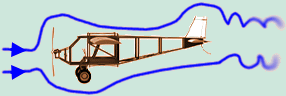
There are four forces of flight -drag, thrust, weight and lift. All four play an important role in how planes fly.
Drag
As the airplane moves through the air, there is an aerodynamic force present. The air resists the motion of the aircraft and the resistance force is calleddrag. Drag is directedalong and opposedto the flight direction. There are many factorsthat affect the magnitude of the drag force including theshapeof the aircraft, the"stickiness"of the air, and the velocityof the aircraft. We collect all of the individual components' drags and combine them into a single aircraft drag magnitude. Drag acts through the aircraft center of pressure. The drag of the air makes it hard for the plane to move quickly. Another name for drag is air resistance. A streamlined shape slips smoothly through the air.
Thrust
To overcome drag, airplanes use a propulsion system to generate a force called thrust. The direction of the thrust force depends on how the engines are attached to the aircraft.
On some aircraft, such as the Harrier, the thrust direction can be varied to help the airplane take off in a very short distance. The magnitude of the thrust depends on many factors associated with the propulsion system including the type of engine, the number of engines, and the throttle setting.
For jet engines, it is often confusing to remember that aircraft thrust is a reaction to the hot gas rushing out of the nozzle. The hot gas goes out the back, but the thrust pushes towards the front. Action <--> reaction is explained by Newton's Third Law of Motion.
Lift As the aircraft moves forward into a stream of air, the wing deflects the air. Some of the air moves to flow above the wing while some of the air moves to flow below the wing. The wing is curved to help the air that flows above the wing move more quickly than the air that was able to flow below the non-curved bottom of the wing. This curve is called an aero-foil wing.
The air that is moving more quickly above the curved wing starts to put less pressure on the wing while it adjusts to its new stream. Meanwhile, the air that is moving at a consistent speed below the wing maintains its rate of pressure. This quick differential produces lift. The higher air pressure pushes the wing upward into the space where the air pressure is lower.The distribution of lift around the aircraft is important for solving the control problem. Aerodynamic surfaces are used to control the aircraft inroll,pitch, andyaw. Weight
Weightis a force that is always directed toward the center of the earth. Themagnitudeof the weight depends on the mass of all the airplane parts, plus the amount of fuel, plus any payload on board (people, baggage, freight, etc.). The weight is distributed throughout the airplane. But we can often think of it as collected and acting through a single point called the center of gravity.In flight, the airplanerotatesabout thecenter of gravity.
The motion of the airplane through the air depends on the relative strength and direction of the forces shown above. If the forces are balanced, the aircraft cruises at constant velocity. If the forces are unbalanced, the aircraft accelerates in the direction of the largest force.
When humans first observed how birds fly in the sky, they realized that it not only took the birds their light weight, and wings to get them flying, they needed speed. And since the day the Wright brothers built the Wright Plane, the propulsion of aircraft has also evolved, and today, the propeller that had propelled once propelled aircraft into the sky, has been replaced by a bigger, more efficient and faster alternative, the jet engine.
Aviation is the youngest of all commercial transport and has the fastest growth as well. Many of us has flown on an aircraft before, yet many of us do not understand how the jet engine works. It is a fairly simple concept really, the idea is to suck air in and blast it out at higher speeds, but the technology involved with it is far more complicated.
To start with, there are 4 types of engines, turbojet, turbofan, propfan, and turboprop.
Propfan
Turbofan
Turbojet
Turboprop
A jet engine works by first sucking in and compressing the surrounding air through the axial compressor. The axial compressor comprises of both moving and stationary blades. The moving blades suck in the air while the stationary ones guide the air and ensures the air enters at the right angle. Then the air flows into the compressor which rotates at very high speed adding energy to the airflow and at the same time squeezing it into a smaller space. They can compress the air in a 44:1 ratio. The air then moves into a combustion chamber where fuel is mixed in with the air and is ignited and the air would flow at a much faster speed. The temperature of this air would melt the turbine so the compressor directs some air into through a separate channel and this cooler air acts as a coolant for the jet engine. The turbine is another series of blades and it would make the air flow faster. The gas then exits through the nozzle and blasts the aircraft forward.
Reverse Thrust
As the name implies, it literally sucks air in from the back and blasts it out from the front. Have you ever noticed when landing, a loud roaring of the engine can be heard, that's reverse thrust taking place, it slows down the plane considerably for landing.
Thrust reversal, also called reverse thrust, is the temporary diversion of an aircraft engine's exhaust or changing of propeller pitch so that the thrust produced is directed forward, rather than aft. This acts against the forward travel of the aircraft, providing deceleration. Thrust reversers are used by many jet aircraft to help slow down just after touch-down, reducing wear on the brakes and enabling shorter landing distances. It is also available on many propeller driven aircraft through reversing the controllable pitch propeller to a negative angle.
Its the time of the year again. The June holidays, and you know what that means! A new Feature topic for the month. This June, let's welcome Aviation Month!
Like Animal Adaptations Month last March, I spent lots of effort designing the graphic. No, but seriously, what I wanted to say is that Aviation of Month will also have a tag, and it will be AV.
I have always have had a passion for aviation In fact, the Aerospace industry is where I want my career to be. I hope you will enjoy Aviation Month as much as I'm excited for it.
Just as I had a 4-part mini series titled "Built for..." for my Animal Adaptations Month, there will also be a 3-part mini series this time around titled "Marvels of Aviation", with the tag MA. The series would feature 3 of the biggest breakthroughs in Aviation history. But, because I think commercial aircraft are way cooler than fighter jets that zoom at mach 3, the articles will only feature commercial aircraft.
Starting tomorrow, this is what you can expect for the whole of June:
On 2nd June - Jet Engines.
On 9th June - Forces of Flight.
On 16th June - Marvels of Aviation - Concorde
On 23rd June - Marvels of Aviation - Boeing 787
On 30th June - Marvels of Aviation - A380
This is the last article in the 4-part mini series, "Built for...", to access the other 3 articles click on the links above this.
Out of millions of animals, 3 are selected based on their outstanding ability to stun, decapitate and absolute demolish their victims, leaving them in shreds. These are the ultimate animals, the top of the food chain, even being in their presence is a mistake. This is Built for Kill.
This is the third article in the 4-part mini series, "Built for...", to access the other 3 articles click on the links above this.
Out of millions of animals, 3 are selected based on their outstanding ability to run, swim or fly in a world of speed that we humans are unfamiliar with, speeds that require the use of slow motion cameras to capture them in all their glory. This is Built for Speed.
Peregrine Falcon
Now this may be the fastest animal on the planet, but it ranks third. Why you ask? Because it gets so much of an advantage. It is only able to reach the speed of 325km/h when it is diving from the air. Repeat: ONLY WHEN IT IS DIVING FROM THE AIR. Anyone could do that if we were to dive from the air as well, but perhaps only once....
In fact, when it is in level flight, it can only fly at about 88km/h. And even though it is still an amazing feat, it is nothing that makes you go "OMG". In fact, the Mantis Shrimp's punch is just as fast as that.
But here are some videos of it.
The falcon has special adaptations in its nostrils which allow it to breathe at such tremendous speed. Each nostril contains a rod and two fins behind it. As air rushes past the nostrils, the flow is broken up and slowed by the rods and fins which enable the falcon to breathe normally without being overwhelmed by the force at which air enters its nostrils. Moreover, the eyes of the peregrine falcon are designed so that the falcon has a clear view of its prey throughout the dive. Each eye is equipped with an nictitating membrane which protects it from dust and other debris in the air and an additional secretory gland to prevent drying up of the cornea. The dark markings around its eyes also reduce glare, improving visual contrast. The animal is also incredibly streamlined. Its also small and light to improve its speed.
Don't get me wrong, these birds are incredible and majestic creatures and are just simply beautiful, and man can only envy its gift of flight, but it just does not cut it to beat the next on our list.
Cheetah
The Cheetah is the world's fastest land animal and lands itself second on our list. It can run at speeds of up to 120km/h, but not for long, tiring out after 500m. It has the ability to accelerate from 0 to 100km/h in just 3 seconds.
Virtually every part of its body is adapted in some way to help it run faster. Special paw pads and semi-retractable claws provide great traction. Large nostrils and lungs provide quick air intake; a large liver, heart and adrenals also facilitate a rapid physical response. A long, fluid, greyhound-like body is streamlined over light bones. Small collarbones and vertical shoulder blades help lengthen the stride. The tail acts as a rudder for quick turning as well.
Just a video of the cheetah showing off its speed, but there's a anticlimax at the end. :(
Here are some awesome photos of the cheetah:
Summary:
Sailfish
This is the animal that wins this little competition. Why? Because it can swim at 110km/h. Underwater. That is unbelievable. It swims so quickly in the environment that has the most resistance and friction. But how?
Well first of all, it probably has the most streamlined shape of all of today's 3 animals. And you probably may notice its very sharp beak, well like jet planes, they possess these because it cuts through the water and makes the sailfish move extremely quickly.
Their sails which attract hoards of their prey, which are fish, will retract when they swim so as to minimise friction as the sailfish swims through the water at top speed.
This is the second article in the 4-part mini series, "Built for...", to access the other 3 articles click on the links above this.
Out of millions of animals, 3 are selected based on their outstanding ability to camouflage, to blend in, and sometimes to seem to disappear completely. This is Built for Camouflage.
Leafy Seadragon
The first animal is the Leafy Seadragon. It is type of seahorse that lives in Southern Australia. The name is derived from the appearance, with long leaf-like protrusions coming from all over the body.
These protrusions are not used for propulsion; they serve only as camouflage. The lobes of skin that grow on the leafy seadragon gives it the appearance of seaweed. It is able to maintain the illusion when swimming, appearing to move through the water like a piece of floating seaweed.
Dead Leaf Butterfly
If you thought that was spectacular, watch this.
This amazing animal is called the dead leaf butterfly. And I am sure you can see that is spectacular. With wings closed, it closely resembles a dry leaf with dark veins and is a spectacular example of camouflage. Its name is also derived from its appearance, as it REALLY closely resembles a dead leaf.
Just look at the detail of the "leaf" that the butterfly has
adapted to form!!!
Chameleon
These animals of course win this race for the best camouflaged animal. It can change from pink, blue, red, orange, green, black, brown, light blue, yellow, turquoise and purple in an instant. And further more, it can change which areas turn what colour, so it can create patterns with its colours as well.
Chameleons have specialized cells, chromatophores, which contain pigments in their cytoplasm, in three layers below their transparent outer skin:
The cells in the upper layer, called xanthophores and erythrophores, contain yellow and red pigments respectively.
Below these is a second layer of cells called iridophores or guanophores; these contain guanine, appearing blue or white.
The deepest layer of cells, melanophores, contain the dark pigment melanin, controlling how much light is reflected.
Dispersion of the pigment granules in the chromatophores sets the intensity of each color. When the pigment is equally distributed in a chromatophore, the whole cell is intensively colored. When the pigment is located only in the centre of the cell, the cell appears mainly transparent. Chromatophores can rapidly relocate their particles of pigment, thereby influencing the animal's color. Chromatophores change because the cells get a message from the brain.
Scientists think that Chameleon changes colour not for camouflage but to express their mood, reflect or absorb heat. That is why, they may seem to be very colourful and doing the opposite of camouflaging.
Not really difficult to spot right?
But, if they were to be able to use it for camouflage, and control each individual cell to match the surroundings, how awesome would that be??? Just the very thought of it, allows the chameleon to deserve the number 1 spot. That and this awesome video. Note: the video has probably the weirdest music I've heard. Ever.
For the next 4 weeks, I will start my "Built for..." series, with 3 animals featured each week. These 3 animals are selected based on their outstanding ability to attract, camouflage, move quickly and kill. They are ranked based on my personal opinions on what has the most spectacular adaptations. Click on the banner above to view the other articles!
Out of millions of animals, 3 are selected based on their outstanding ability to attract a mate whether its through croaking, through scent or just through plain old looks. This is Built for Attraction.
Peacocks
1. During the breeding season, peacocks choose special places to perform their courtship dance and they tend to return to the same location year after year. Other males may be doing the same thing close by and peahens will window-shop-the peacock with the best display wins.
2. When a peahen comes close enough, the peacock turns his back and brings his train erect, displaying the underlying tail feathers and his dark wings, which he flutters rapidly, From this angle, the brilliant colours of the display feathers can't be seen-the bird is predominantly grey and brown. The peacock steps from side to side and sometimes moves forward or backward a few steps. 3. When the peahen comes closer still, the peacock backs up towards her, and when she avoids him, he turns, revealing all his colour and holding his wings still. He then drops the great fan down on top of the female. It quivers, making a rustling sound. 4. The peahen may mate with the peacock, or she may simply walk away or stand still, whereupon the male starts over, turning his back again and resuming the rapid fluttering of his wings. The peacock can hold his fan of display feathers up for a very long time. 5. For reasons that are not well understood, peahens tend to mate with peacocks with the most eye-spots.
Angler Fish
Yup... That scary guy from Nemo...
Seriously, these fish have the coolest mating ritual.
Anglerfish, a deep sea fish named for the spiny appendage on its head that it uses as bait to "fish" its prey, has an unusual mating habit. As it spends its time in the bottom of the ocean, finding a mate is a problem - but the species solved this evolutionary challenge beautifully.
At first, scientists were perplexed because they've never caught a male anglerfish. Also, all female anglerfish have a lump on their body that looks like a parasite. Only later did scientists discover that the lump is the remain of the male fish.
The tiny male anglerfish are born without any digestive system, so once they hatch, they have to find a female quickly. When a male finds a female, he quickly bites her body and releases an enzyme that digests his skin and her body to fuse the two in an eternal embrace. The male then wastes away, becoming nothing but a lump on the female anglerfish's body!
When the female is ready to spawn, her "male appendage" is there, ready to release sperms to fertilize her egg.
This post will look at the extra or enhanced senses that some animals have developed to adapt to its environment.
Enhanced Sight
Now, when you first saw the heading, you must have been like, well he would obviously talk about the bald eagle. Well that is just too mainstream. I will talk about a lesser known creature. The Mantis Shrimp.
It is believed to possess the most complex eyes in the entire animal kingdom.
I'm sure you all know about the visible spectrum of light. What we can see, is just a small fraction of electromagnetic radiation.
But what the mantis shrimp is amazing. It can see everything from Ultraviolet to infrared light and even polarized light!
So let's first discuss how they can use their ultraviolet sight. Well what ultraviolet allows you to do is to analyse the history of an object. Like knowing that dinosaur bones are hollow and that ancient Greek statues were actually painted just by looking at it. Seeing infrared light can allow it to see an invisible laser alarm system, read data of a Blu-ray disc, and see how hot or cold something is.
So, why do they get awesome eyesight and I don't???
They prey on animals that or often semi transparent or transparent, so they need to be able to sense different types of radiation to find their prey. Also because they hunt using very rapid movement of their claws, they require very accurate ranging information which would require very accurate depth perception.
Internal GPS
The monarch butterfly's migration in North America every spring looks like the sort of poorly planned, uncoordinated mass migrations you expect from the Animal Kingdom, with hundreds of millions spreading out across North America. In August, they fly back South. But here's where things get spooky. All hundred million of them fly back to the same patch of trees in Mexico, that patch of trees is the 1/100th the size of New York's Central Park.
But here is when it really gets creepy till the point that science cannot explain. These migrations take place over a year. The butterflies live for only a few months. That means the migrations span generations. Every August, hundred of millions of butterflies stretch out from their pupae and begin to fly to the exact patch of trees that their great-grandfathers left a year ago. Right of the bat when they are born, they already know how to fly to the home of their great-grandfather without their mothers telling them how, or without knowing who their great-grandfather is, or even without knowing what a great-grandfather is because obviously they are butterflies and could not possibly have known. Allow me to emphasize their achievement. We can only return to our own home from an unknown location through the help of a GPS. They do that without even knowing where home is.
So why do thy get an internal GPS and I don't?
Well, perhaps its because we got the bigger brain and could learn how to make one. Nature just loves making our lives difficult. Maybe that's why humans are taking revenge on it through deforestation and releasing carbon emissions and extensive hunting and killing and forcing species into extinction. Maybe.
Just kidding. Seriously, Global Warming is bad and it needs to stop now.
Echolocation
Echolocation is essentially biological sonar. Animals that can echolocate emit calls to their environment, and listen to the echos of those calls that return from various objects that use them. They use these calls to locate and identify the objects. There are many animals that can echolocate like bats being most notable, but I would like to do my case study on dolphins because they just look a lot cuter.
I mean seriously. What kind of coldblooded creature must you be
to not want to give this guy a big hug.
Dolphins use echolocation to navigate their way around the sea as well as for hunting prey. Dolphins live in the sea so their visibility is very limited and furthermore, sound travels faster in water. echolocation is very favourable in the sea. They emit a focused beam of high frequency clicks in the direction their head is pointing.
Sounds are generated by passing air from the bony nares through the phonic lips. The focused beam is modulated by a large fatty organ known as the 'melon'. This acts like an acoustic lens because it is composed of lipids of differing densities.
Dolphins use clicks in a series. Echolocation literally sonar, using sounds made by the animal itself. Ranging is done by measuring the time delay between the animal's own sound emission and any echoes that return from the environment. Animal echolocation has only one transmitter and two receivers which are the ears. Echolocating animals have two ears positioned slightly apart. The echoes returning to the two ears arrive at different times and at different loudness levels, depending on the position of the object generating the echoes. The time and loudness differences are used by the animals to perceive distance and direction. With echolocation, the bat or other animal can see not only where it is going but also how big another animal is, what kind of animal it is, and other features.
Electroreception
Sharks are able to "sense" electricity. My case study is he Hamerhead Shark, which just so happens to also have enhanced smell, and better vision than most sharks, having 360 degrees of vertical binocular vision.
Nobody told me I had 360 degrees vertical binocular vision?!?!?!
But obviously, their most impressive ability is the ability to use their hammer head as a natural minesweeper, detecting the minutest electrical signal over vast distances or through mud. All sharks have receptors called ampullae of Lorenzini, which actually sounds more like a pasta dish than a super-sensory organ. Hammerheads just have more of them, and they are spread out over that giant head, giving them something similar to an electrical signal detecting radar array on their face.
As a result, hammerheads can detect half a billionth of a volt. For some perspective, when you drive around in your car on a dry day, then get out and zap yourself on the door handle, that's because your body built up about 8,000 to 10,000 volts of static. That is more than a trillion times the voltage needed for a hammerhead to find you, even if you are hiding in an underground bunker at the bottom of the goddamn ocean. Because of this, hammerheads are able to easily find just about anything on the bottom of the ocean that tries to hide from them.
Yeah, I think its time we all spend a moment to be thankful of the fact that we live on land, not in the sea, because it seems like a pretty messed up world to live in.
The Mantis Shrimp's punch is delivered at 50mph and keep in mind that the shrimp is doing this underwater. Think back to the last time you were at the pool and you tried to no avail to run through it and ended up stupidly flailing you arms and legs in slow motion. In fact, it is known to break aquarium glass.
The dolphin can blast soundwaves at you and estimate how you look like, where you might swim to in the next minute and where you are with pinpoint accuracy. Even when you hide in the seabed, the hammerhead can find you, and gobble you up for dinner.